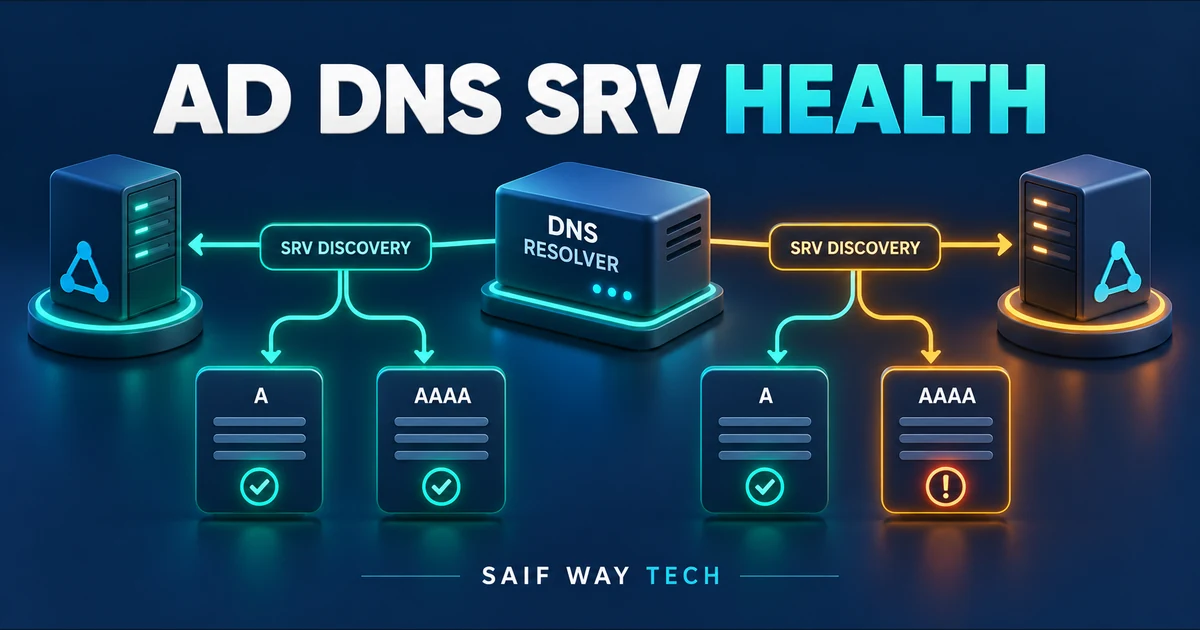
An SRV answer can advertise a domain controller whose address record is missing. A normal hostname lookup does not inspect that dependency chain. Query the intended AD discovery name, preserve each SRV target and resolve its A and AAAA records separately so partial DNS results stay visible.
Scope and evidence: Proposed Python 3.10+ diagnostic using dnspython 2.x and an explicitly selected authorized AD DNS server 192.0.2.53. Domain example.test, targets and addresses are documentation fixtures. The query is _ldap._tcp.dc._msdcs.example.test.. No real directory, DNS response or working domain join is claimed. Site-specific discovery, multiple forests and application-specific address-family policy require additional checks.
Define the Scope of an AD SRV and Target-Address Check
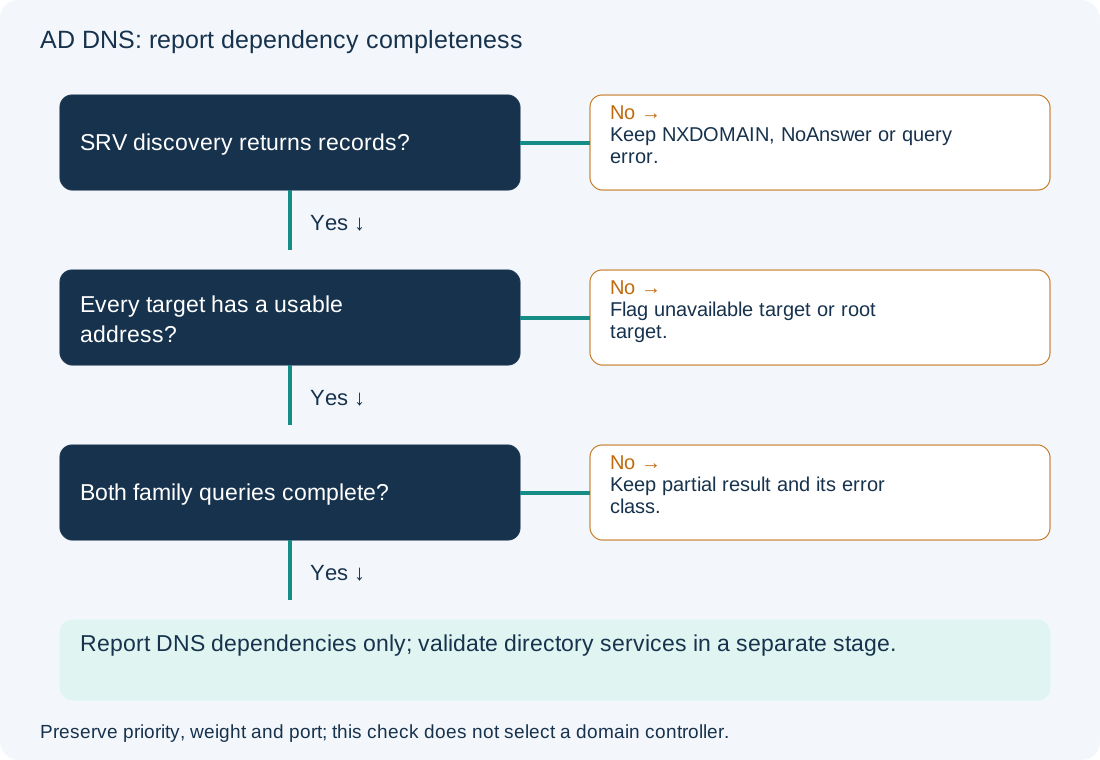
This check asks whether the selected resolver returns discovery records and at least one address for each advertised target. It does not validate LDAP, Kerberos, RPC, DC Locator selection, replication or the full AD join workflow. An IPv4 address with AAAA NoAnswer can be usable in an IPv4 design; a timeout for AAAA is still an unresolved query even when A works. Keep both the usable-address observation and query completeness.
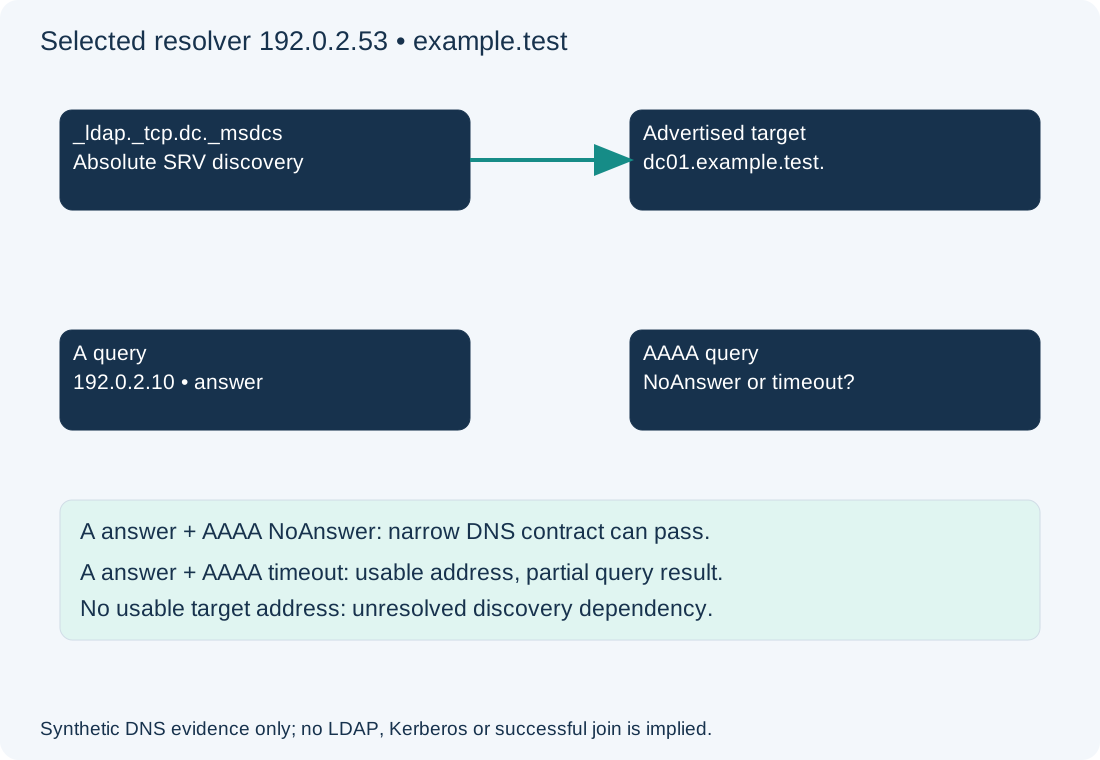
The SRV specification defines priority, weight, port and target, including the root target indicating service unavailability. This diagnostic preserves those fields but does not implement weighted server selection. It inspects every advertised target rather than choosing one and hiding failures in the others. For manual directory discovery, use the AD DNS guide.
Python Example: Classify dnspython SRV and Address Query Errors
Save the following Python code as ad_dns_check.py. The adapter uses dnspython’s documented Resolver interface. It disables search-list expansion by using an absolute query and search=False, and separates timeout, NXDOMAIN, NoAnswer and no-usable-nameserver outcomes. NoNameservers is not equivalent to network timeout; inspect resolver-side diagnostics for errors such as SERVFAIL or refusal. See the dnspython resolver API.
import json

def dns_query(resolver, name, kind):
    import dns.exception
    import dns.resolver
    try:
        answer = resolver.resolve(name, kind, search=False)
        if kind == "SRV":
            values = [dict(priority=r.priority, weight=r.weight,
                           port=r.port, target=str(r.target)) for r in answer]
        else:
            values = [str(r) for r in answer]
        return {"status": "answer", "values": values}
    except dns.resolver.NXDOMAIN:
        return {"status": "nxdomain", "values": []}
    except dns.resolver.NoAnswer:
        return {"status": "no_answer", "values": []}
    except dns.exception.Timeout:
        return {"status": "timeout", "values": []}
    except dns.resolver.NoNameservers:
        return {"status": "no_nameservers", "values": []}
    except dns.exception.DNSException:
        return {"status": "dns_error", "values": []}

def inspect_discovery(query, name):
    srv = query(name, "SRV")
    report = {"query": name, "srv": srv, "targets": [],
              "scope": "DNS dependencies only"}
    if srv["status"] != "answer":
        report["status"] = "discovery_failed"
        return report
    for record in srv["values"]:
        target = record["target"]
        if target == ".":
            report["targets"].append({**record, "status": "service_unavailable"})
            continue
        addresses = {kind: query(target, kind) for kind in ("A", "AAAA")}
        usable = any(v["status"] == "answer" and v["values"]
                     for v in addresses.values())
        complete = all(v["status"] in ("answer", "no_answer")
                       for v in addresses.values())
        report["targets"].append({**record, "addresses": addresses,
                                  "usable_address": usable,
                                  "queries_complete": complete})
    healthy = bool(report["targets"]) and all(
        t.get("usable_address", False) and t.get("queries_complete", False)
        for t in report["targets"])
    report["status"] = "dns_dependencies_ok" if healthy else "partial_or_unavailable"
    return report
dns_dependencies_ok means the narrow contract is satisfied; it is not a full DNS or AD health certificate. A positive address plus an error in the other family is reported as partial. NXDOMAIN on one address query is not silently downgraded to NoAnswer, even if a previous query returned a value; that contradiction deserves investigation. Duplicate targets are deliberately retained per SRV record in this small example. A production collector should cache per-target queries and bound total records, runtime and concurrency.
Test AD DNS Dependency Reporting with Offline Fixtures
Append this synthetic fixture. Running python ad_dns_check.py at this point uses only the provided dictionary, with no dnspython import or network request:
if __name__ == "__main__":
    name = "_ldap._tcp.dc._msdcs.example.test."
    rows = {
        (name, "SRV"): {"status": "answer", "values": [
            dict(priority=0, weight=100, port=389, target="dc01.example.test.")]},
        ("dc01.example.test.", "A"): {"status": "answer", "values": ["192.0.2.10"]},
        ("dc01.example.test.", "AAAA"): {"status": "no_answer", "values": []},
    }
    report = inspect_discovery(lambda name, kind: rows[(name, kind)], name)
    assert report["status"] == "dns_dependencies_ok"
    rows[("dc01.example.test.", "AAAA")] = {"status": "timeout", "values": []}
    partial = inspect_discovery(lambda name, kind: rows[(name, kind)], name)
    assert partial["status"] == "partial_or_unavailable"
    assert partial["targets"][0]["usable_address"] is True
    print("2 offline fixtures passed")
Expected output is 2 offline fixtures passed. The fixture proves dependency reporting for its synthetic cases, not real Resolver exception behavior. Keep separate fixture coverage for discovery failure, missing target addresses and root target before adopting the example in a collector.
Run an Approved AD DNS Check with an Explicit Resolver
Network collection change: create an isolated Python environment and install an organization-approved, pinned dnspython 2.x version. This local article review does not install or query it. After that review, a separate caller can construct the resolver and invoke the functions:
import json
import dns.resolver
from ad_dns_check import dns_query, inspect_discovery
resolver = dns.resolver.Resolver(configure=False)
resolver.nameservers = ["192.0.2.53"]
resolver.timeout = 2.0
resolver.lifetime = 4.0
result = inspect_discovery(
    lambda name, kind: dns_query(resolver, name, kind),
    "_ldap._tcp.dc._msdcs.example.test.")
print(json.dumps(result, indent=2))
Save that as a separate caller importing dns_query and inspect_discovery from ad_dns_check; do not append it to the offline fixture run unless live collection is intended. Nameserver selection is explicit so a public resolver is not mistaken for an AD resolver. The lifetime limit is per question, not a whole-run deadline; two families times multiple targets can take substantially longer. Bound the complete job and authorized target count in production.
Verify the selected resolver, exact absolute query and per-target outcomes against an authorized manual lookup before rollout. A DNS-valid target may still be unreachable or advertise the wrong service port; investigate those separately. For actual directory failures, preserve evidence and consult the AD discovery guide. Clock-sensitive authentication has its own Windows Time checks.
Rollback disables the scheduled caller and restores the prior reporting/template configuration, retaining the raw query outcomes securely. The script performs no DNS updates and authorizes no record deletion. Correct authoritative DNS through its owner after the failed dependency is proven; do not remove an SRV target merely because one bounded poll timed out.