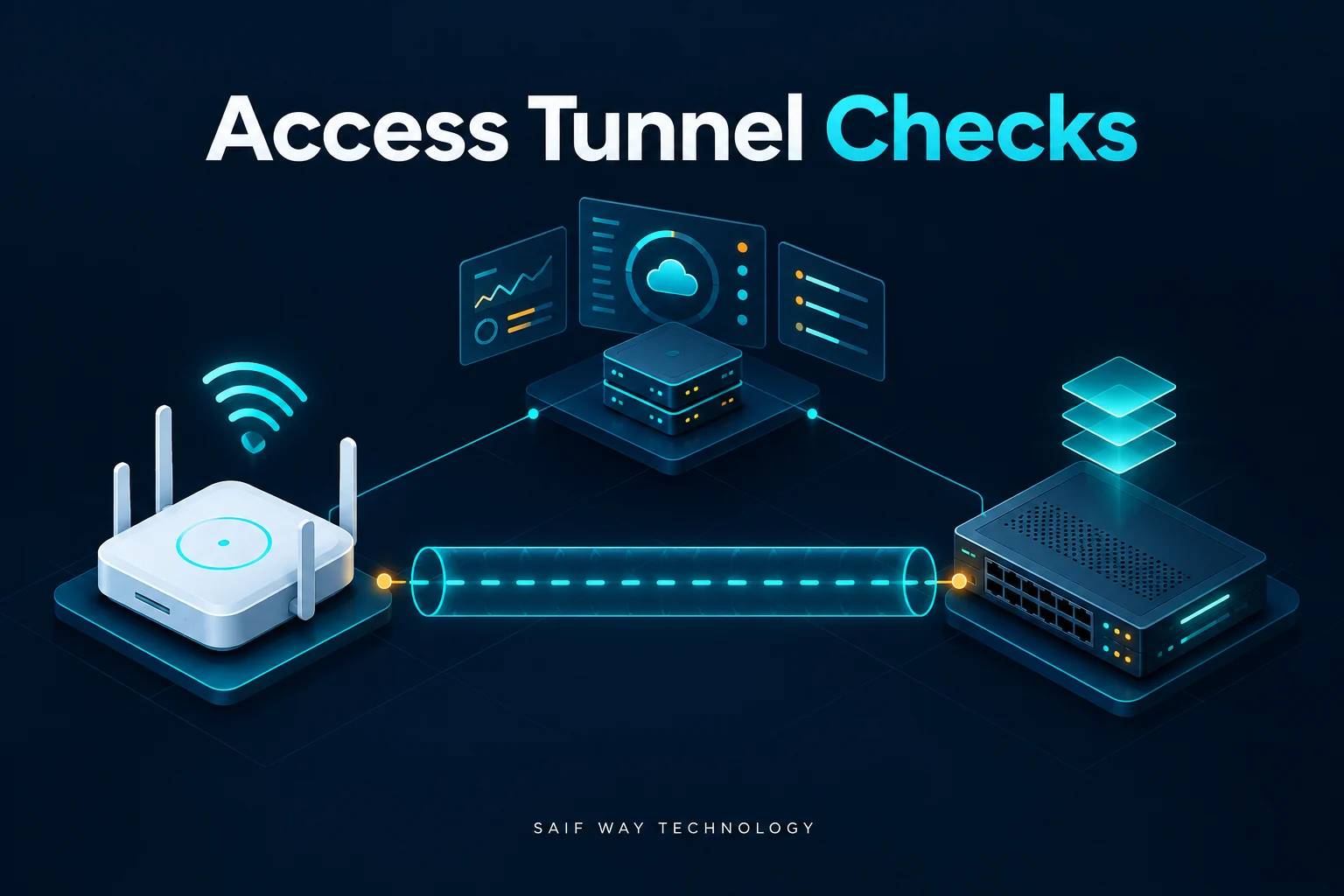
An AP appears in the wireless controller, but the expected fabric access tunnel is missing at the edge. Treat AP connectivity, controller state and fabric context as separate observations before deciding which component needs correction.
Lab status: This is a proposed exercise, not a completed device test or client case study. Code examples require validation against your image and dependency versions. Controller/fabric platform access is not confirmed; offline samples demonstrate report logic only. My documented background is NOC/data center operations, multi-vendor Netmiko workflows and Python/Flask integration.
Offline example checks: October 20, 2026: the added helper/demo block executed with local fixtures, and related negative cases were checked offline. No live device, controller, fabric or service behavior was validated.
What does a missing fabric access tunnel establish?
It identifies an expected state that has not been observed at the collection point. First confirm that the AP, edge and site are actually part of the intended fabric-enabled wireless design. A conventional wireless deployment does not become a fabric deployment merely because the controller manages the AP.
AP join, fabric registration and access-tunnel creation are separate states. A missing row in an unverified collection is not proof of a missing tunnel. Establish the intended design, AP identity and fabric site before declaring the edge wrong.
Why compare AP, WLC and fabric-edge observations?
Correlate AP identity and attachment context across WLC, control plane and edge observations collected in the same window. If the AP moved between edges, old and new records can disagree legitimately. Keep timestamps and avoid joining by display name alone.
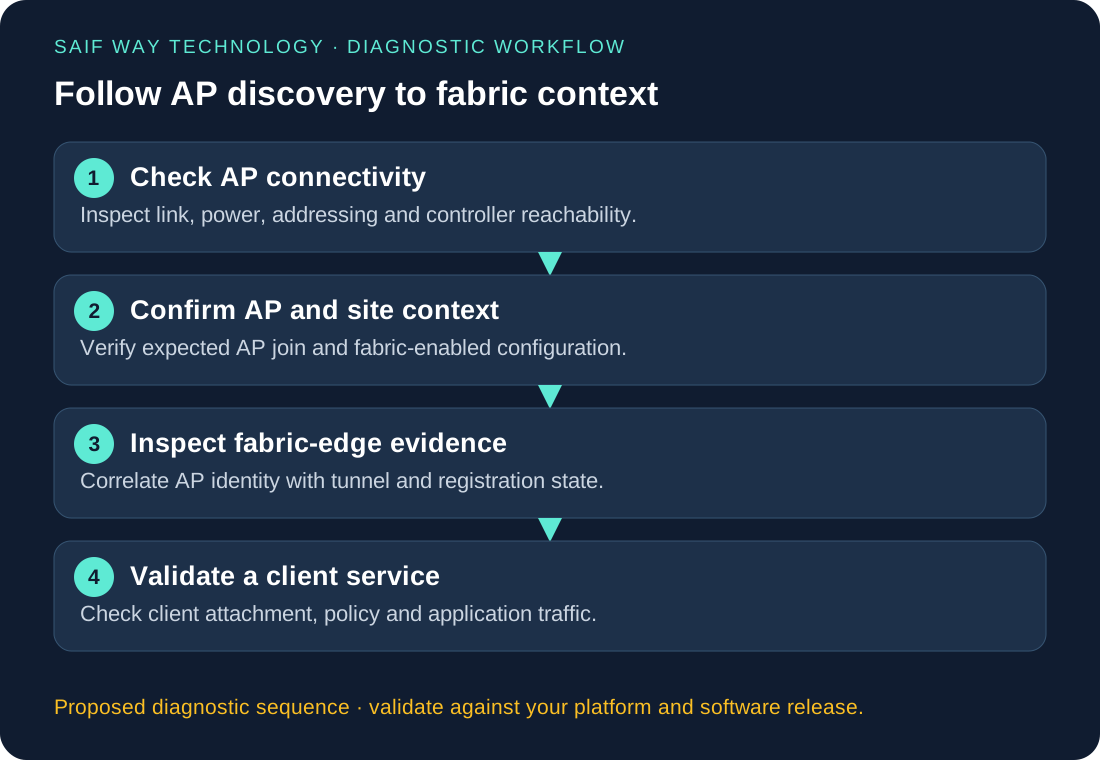
Proposed fabric-wireless lab: confirm platform access
The proposed live exercise needs a supported fabric-wireless design and its AP/WLC/edge roles. These are unconfirmed resources. The safe local exercise is to test identity mismatch, site mismatch, missing evidence and an observed tunnel using labeled fixtures.
Python: correlate synthetic AP and fabric inventory records
The added helper validates AP/site alignment before using joined/tunnel booleans. The dictionaries are a normalized evidence contract. They are not output from a tested WLC or a Cisco API schema, and a matching pair still requires a client-service check.
aps = [{"id": "ap-example-1", "edge": "edge-example-1"}]
tunnels = []  # Synthetic empty collection; not a real device result
collection_ok = True
for ap in aps:
    found = any(t.get("ap_id") == ap["id"] and
                t.get("edge") == ap["edge"] for t in tunnels)
    status = "unknown" if not collection_ok else ("observed" if found else "not-observed")
    print({"ap_id": ap["id"], "edge": ap["edge"], "tunnel": status})
Worked Python example and input contract
def tunnel_evidence(ap, edge):
    if not isinstance(ap, dict) or not isinstance(edge, dict):
        return {'state': 'unknown_evidence'}
    if not ap.get('ap_id') or ap.get('ap_id') != edge.get('ap_id'):
        return {'state': 'identity_mismatch'}
    if ap.get('fabric_site') != edge.get('fabric_site') or not ap.get('fabric_site'):
        return {'state': 'fabric_context_mismatch'}
    if type(ap.get('joined')) is not bool or type(edge.get('access_tunnel')) is not bool:
        return {'state': 'unknown_evidence'}
    return {'state': 'checks_match_requires_client_test' if ap['joined'] and edge['access_tunnel']
            else 'review_required'}

ap = {'ap_id': 'lab-ap', 'fabric_site': 'lab-site', 'joined': True}
edge = {'ap_id': 'lab-ap', 'fabric_site': 'lab-site', 'access_tunnel': False}
print(tunnel_evidence(ap, edge))  # Normalized synthetic evidence only
Which physical and logical prerequisites need investigation?
Check the AP’s physical port, intended fabric context, controller join and the release-specific registration/tunnel prerequisites in Cisco’s guide. Collect both expected and observed state at each role. Do not toggle fabric settings or rejoin APs merely to probe a reporting hypothesis.
What evidence should confirm access-tunnel recovery?
Confirm the expected tunnel at the correct edge, then validate client association, address assignment, policy and an application transaction. A recovered infrastructure tunnel does not by itself establish that every wireless client works.
What should a fabric-wireless review include?
A scoped engagement can turn a worksheet into a protected evidence report once the platform owner supplies validated data sources. Keep unsupported platform access and untested transitions explicit in the handover.
Related troubleshooting and implementation
Explore the network automation troubleshooting collection to connect this issue to adjacent workflows. The Netmiko, NETCONF and RESTCONF comparison helps when you are choosing an interface rather than fixing an existing implementation.