A script requests the startup datastore and receives an unsupported-capability error. The right response is to inspect what the server actually advertises. A workflow designed for one network operating system may rely on optional behavior that another device does not provide.
Lab status: This is a proposed exercise, not a completed device test or client case study. Code examples require validation against your image and dependency versions. My documented background is NOC/data center operations, multi-vendor Netmiko workflows and Python/Flask integration.
Offline example checks: October 20, 2026: the added helper/demo block executed with local fixtures, and related negative cases were checked offline. No live device, controller, fabric or service behavior was validated.
How does a NETCONF server advertise capabilities?
Capabilities describe protocol features and models available in a session. Optional features include particular datastores and operations. The existence of a NETCONF listener does not mean every example from the internet is applicable. Record the advertised identifiers with the device version as part of your inventory.
Capabilities are server-advertised protocol features. Optional datastore capabilities use exact URIs; a substring search for startup can accidentally match unrelated text. Strip query parameters only when comparing the capability identifier, and keep the original list in restricted evidence.
How do running, candidate and startup datastores differ?
Running represents active configuration; candidate is an optional staging datastore; startup is optional persistent startup configuration. Reading running does not imply writable-running or startup support. Candidate support does not mean a commit succeeded, and this read-only guide performs no commit.
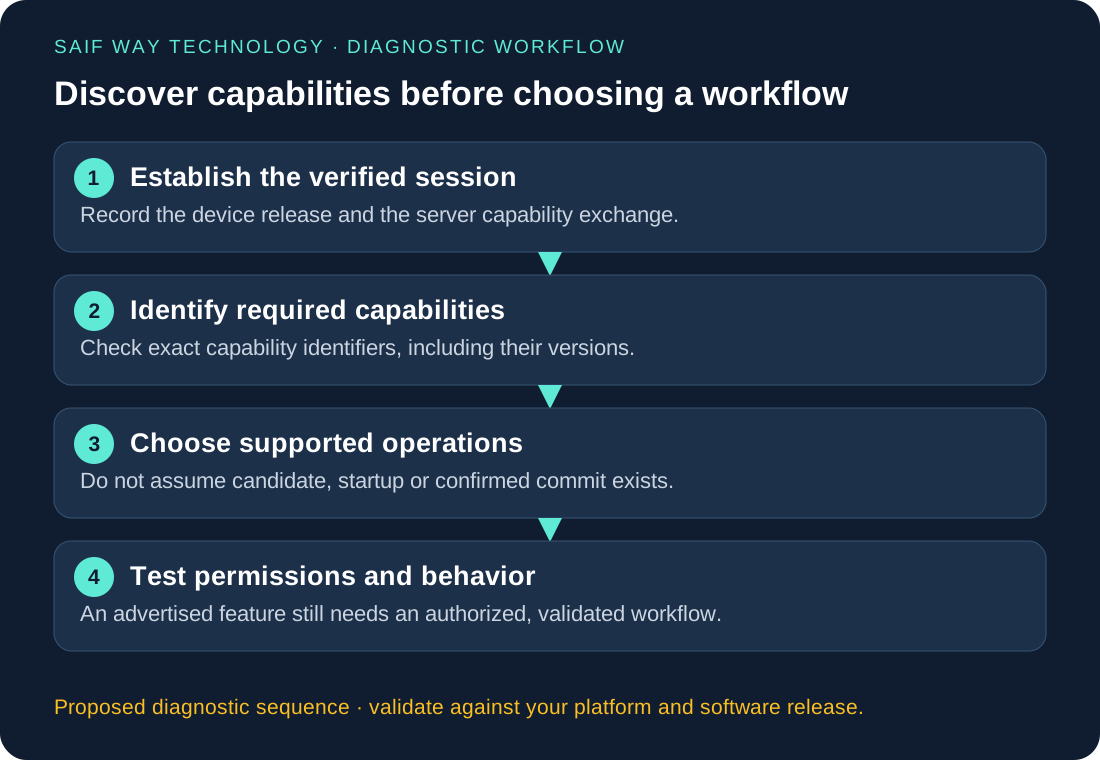
Proposed lab: inspect the advertised datastore capabilities
Start with the normal known-host-verified ncclient connection below on TCP 830, if supported. Compare actual advertised capabilities with two synthetic URI lists. Keep an unsupported optional feature visible rather than forcing the script to use another datastore silently.
Python: check startup support without writing configuration
The helper produces independent support flags. It intentionally does not describe running as unreadable when :writable-running is absent: that capability concerns writing. Use these flags to choose an explicitly approved workflow rather than to attempt arbitrary fallback operations.
import os
from getpass import getpass
from ncclient import manager

with manager.connect(
    host=os.environ['LAB_HOST'], port=830,
    username=os.environ['LAB_USER'], password=getpass('NETCONF password: '),
    hostkey_verify=True, allow_agent=False, look_for_keys=False,
    timeout=20,
) as session:
    capabilities = {str(item).split('?')[0]
                    for item in session.server_capabilities}
    startup = 'urn:ietf:params:netconf:capability:startup:1.0'
    print({'startup_advertised': startup in capabilities})
Worked Python example and input contract
def datastore_support(capabilities):
    # Optional capability identifiers are exact URIs; strip only query parameters.
    names = {str(c).split('?', 1)[0] for c in capabilities}
    prefix = 'urn:ietf:params:netconf:capability:'
    return {'startup': prefix+'startup:1.0' in names,
            'candidate': prefix+'candidate:1.0' in names,
            'writable_running': prefix+'writable-running:1.0' in names}

sample = ['urn:ietf:params:netconf:base:1.0',
          'urn:ietf:params:netconf:capability:candidate:1.0']
print(datastore_support(sample))  # Synthetic hello capability list
How should datastore support shape the client workflow?
If startup is absent, report unsupported_startup and ask which persistent-source workflow the platform owner supports. Do not replace get_config(source='startup') with a write or assume retrieving running proves persistence across reload.
Dashboard reporting: distinguish unsupported from failed
Show device identity, collection time, advertised capability and selected operation. Unsupported, unavailable and failed are separate states. A stale previously collected value must retain its age after a capability query fails.
What should a capability-aware handover include?
Retain one exact capability fixture per supported image and negative cases where optional features are absent. Verify the actual read-only RPC on the image before promising datastore coverage to a client.
Related troubleshooting and implementation
Explore the network automation troubleshooting collection to connect this issue to adjacent workflows. The Netmiko, NETCONF and RESTCONF comparison helps when you are choosing an interface rather than fixing an existing implementation.