An SD-WAN device appears out of sync with its template. Reattaching immediately may overwrite a deliberate local adjustment or repeat a failing operation. First establish which management model applies and what the controller and device each report.
Lab status: This is a proposed exercise, not a completed device test or client case study. Code examples require validation against your image and dependency versions. Controller/fabric platform access is not confirmed; offline samples demonstrate report logic only. My documented background is NOC/data center operations, multi-vendor Netmiko workflows and Python/Flask integration.
Offline example checks: October 20, 2026: the added helper/demo block executed with local fixtures, and related negative cases were checked offline. No live device, controller, fabric or service behavior was validated.
What does an out-of-sync template status establish?
It indicates a mismatch in the controller’s view of configuration synchronization. It does not by itself identify the changed command, why the mismatch occurred or whether a user-facing service is affected. Classic device templates and newer configuration-group workflows need different documentation and APIs.
Keep classic device/feature templates separate from configuration groups and other management models. A controller status flag is one observation, not a normalized configuration diff. Record device ID, management model and collection time before joining records.
Why inspect the configuration task history before reattaching?
A failed attachment task may explain why intended state was never applied. A successful task followed by drift suggests another sequence. Retain the task reference and sanitized failure category; do not infer chronology from screenshots taken at different times.
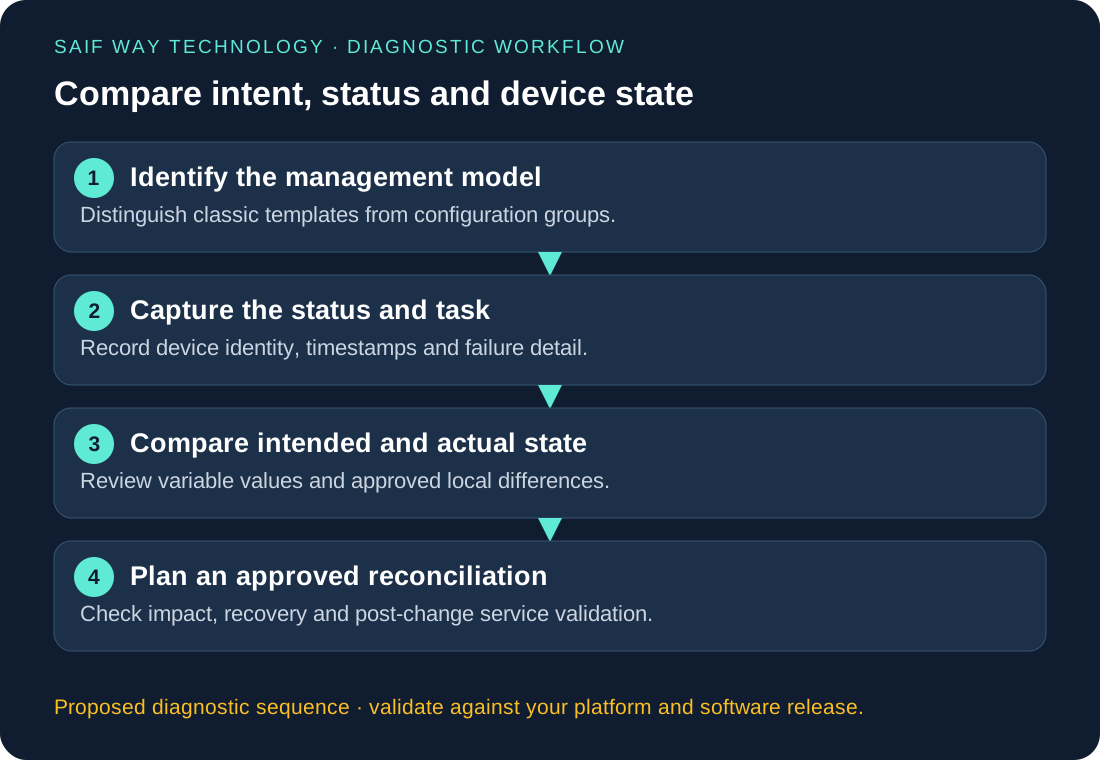
Proposed SD-WAN lab: collect controller and device evidence
Use saved, redacted controller records first. A later live collector needs the exact supported status endpoint and a version-specific schema adapter. Capture the controller view, device readback and related task together. Existing GNS3/EVE-NG access alone does not validate Manager API behavior.
Python: compare saved configuration text offline
The stronger helper below checks identity/model alignment before treating the normalized status as evidence. Its dictionaries are an application schema, not a claim that Manager returns those exact keys. A missing status or mismatched device stays unknown; no branch reattaches a template.
from pathlib import Path
from difflib import unified_diff

intended = Path("intended.txt").read_text(encoding="utf-8").splitlines()
observed = Path("observed.txt").read_text(encoding="utf-8").splitlines()
for line in unified_diff(intended, observed,
                         fromfile="intended", tofile="observed", lineterm=""):
    print(line)
Worked Python example and input contract
def sync_evidence(controller, device, task):
    if not isinstance(controller, dict) or not isinstance(device, dict) or not isinstance(task, dict):
        return {'state': 'unknown_evidence'}
    keys = ('device_id','management_model')
    if any(not controller.get(k) or controller.get(k) != device.get(k) for k in keys):
        return {'state': 'identity_or_model_mismatch'}
    if controller.get('sync') not in ('in_sync','out_of_sync'):
        return {'state': 'unknown_sync_state'}
    return {'state': 'review_required' if controller['sync']=='out_of_sync' or task.get('failed') is True
            else 'reported_in_sync_requires_readback', 'auto_reattach': False}

controller = {'device_id': 'lab-edge', 'management_model': 'classic_template',
              'sync': 'out_of_sync'}
device = {'device_id': 'lab-edge', 'management_model': 'classic_template'}
print(sync_evidence(controller, device, {'failed': True}))  # Synthetic evidence
How can API collection support sync-status reporting?
Use the release’s read-only APIs for status and task details, then map documented identifiers into the application schema. Treat pagination failure or missing rows as incomplete collection. A text diff remains supporting evidence and must not be described as a full controller collector.
What approvals and comparisons should precede reconciliation?
Before any approved reconciliation, retain both views, the local-change rationale, ownership and rollback criteria. Determine whether a local difference is intentional. Reattachment can overwrite a deliberate device change; a report should request review rather than perform it.
What should a configuration-drift integration cover?
Deliver a read-only evidence join and review queue with stale/unknown states and task links. The supported version matrix and live acceptance remain separate project work. A mock test verifies the join logic, not template attachment or configuration-group support.
Related troubleshooting and implementation
Explore the network automation troubleshooting collection to connect this issue to adjacent workflows. The Netmiko, NETCONF and RESTCONF comparison helps when you are choosing an interface rather than fixing an existing implementation.