
A WAN edge cannot establish its control connections and the error mentions a certificate or identity. A certificate date check is useful, but it is only one part of the investigation. Trust, authorization, organization context and transport can all matter.
Lab status: This is a proposed exercise, not a completed device test or client case study. Code examples require validation against your image and dependency versions. Controller/fabric platform access is not confirmed; offline samples demonstrate report logic only. My documented background is NOC/data center operations, multi-vendor Netmiko workflows and Python/Flask integration.
Offline example checks: October 20, 2026: the added helper/demo block executed with local fixtures, and related negative cases were checked offline. No live device, controller, fabric or service behavior was validated.
Which identity, trust and clock evidence separates failures?
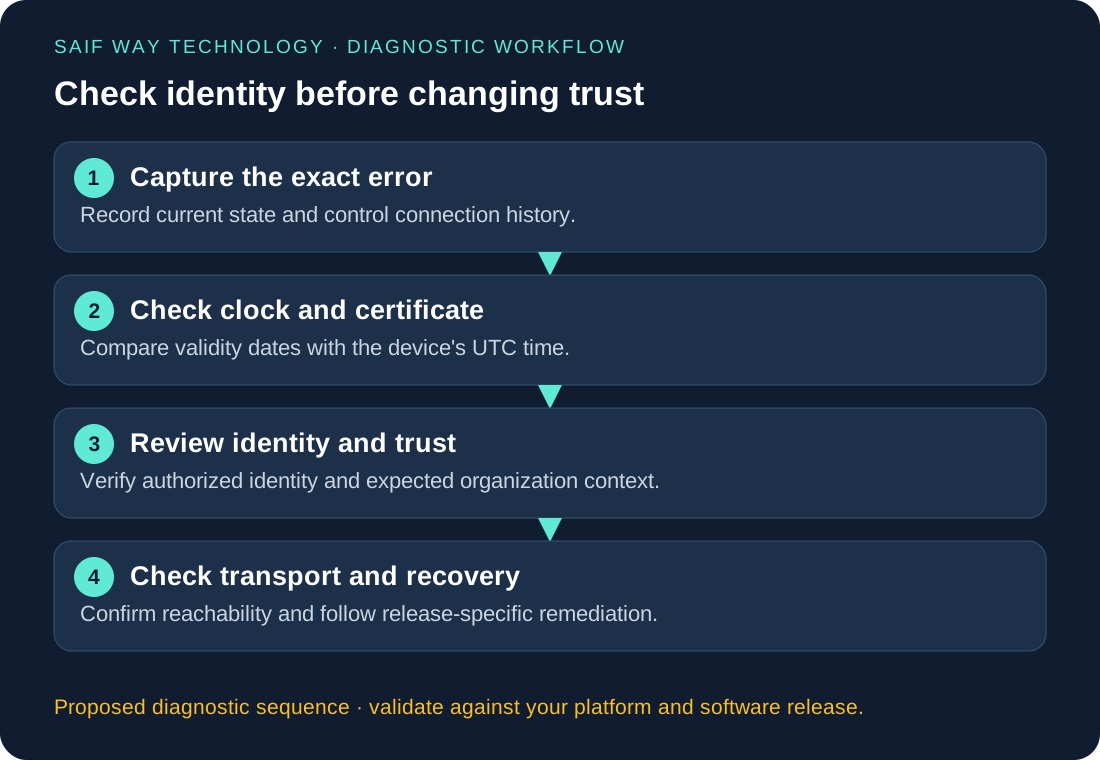
Capture current control connections, connection history, software versions and the exact reason code. Record device UTC time and synchronization state. Compare certificate validity to the device clock, not just an engineer’s laptop clock. A certificate that is within its validity period may still fail trust or identity checks.
Capture the exact reason code with identity, organization context, trust evidence, device time and certificate validity. CRTVERFL indicates certificate verification failure; it does not uniquely identify expiry. Other control errors need their own platform-specific branches.
Why capture the control-connection error before remediation?
A valid date range does not establish trusted issuer, authorized serial/chassis identity or matching organization. Preserve the original failure code before re-enrollment or renewal, because those actions can change evidence and access state.
Proposed SD-WAN lab: define certificate-test boundaries
Use synthetic reason/evidence records first. Live trust and identity changes require the responsible SD-WAN owner and supported platform access. Record the exact release and use the current troubleshooting guide for that device family; no live certificate failure was reproduced for this draft.
Python: check a synthetic certificate validity window
The added case evaluator requires explicit evidence for organization, trust and authorization as well as timezone-aware validity dates. None means not checked; it cannot become True merely because a date is valid. Boolean fields are normalized observations supplied by an adapter or engineer, not parsed controller output.
from datetime import datetime, timezone

def validity_state(not_before, not_after, now):
    if now < not_before:
        return "not-yet-valid"
    if now >= not_after:
        return "expired"
    return "within-validity-window"

start = datetime(2026, 1, 1, tzinfo=timezone.utc)
end = datetime(2027, 1, 1, tzinfo=timezone.utc)
sample_time = datetime(2026, 10, 19, tzinfo=timezone.utc)
print(validity_state(start, end, sample_time))
Worked Python example and input contract
from datetime import datetime, timezone

def certificate_case(case, now):
    required = ('reason_code','organization_matches','trusted_chain','authorized_identity','not_before','not_after')
    if any(key not in case for key in required):
        return {'state': 'unknown_evidence'}
    before = datetime.fromisoformat(case['not_before'])
    after = datetime.fromisoformat(case['not_after'])
    if before.tzinfo is None or after.tzinfo is None or now.tzinfo is None or after <= before:
        raise ValueError('valid_aware_time_range_required')
    checks = {k: case[k] for k in required[1:4]}
    checks['within_validity'] = before <= now <= after
    if any(v is not None and type(v) is not bool for v in checks.values()):
        raise ValueError('invalid_evidence_type')
    return {'state': 'review_required' if False in checks.values() else
            'unknown_evidence' if None in checks.values() else 'checks_match_not_connection_proof',
            'checks': checks, 'reason_code': case['reason_code']}

case = {'reason_code': 'CRTVERFL', 'organization_matches': True,
        'trusted_chain': None, 'authorized_identity': True,
        'not_before': '2026-01-01T00:00:00+00:00',
        'not_after': '2027-01-01T00:00:00+00:00'}
print(certificate_case(case, datetime(2026, 10, 20, tzinfo=timezone.utc)))
# Synthetic evidence: a valid date cannot resolve unknown trust.
Which platform checks should follow the date check?
On supported IOS XE SD-WAN, begin with show sdwan control connection-history, show sdwan control local-properties and show clock. Confirm command support on the image. Correlate the reason with the owner-approved trust/identity records. Do not distribute private keys or replace CA material as an exploratory script action.
What should certificate and control-connection recovery verify?
Verify expected control sessions under the original identity policy, then confirm intended data-plane/service state separately. Retain the final reason-code history and the approved correction. Certificate renewal alone is not proof that the original authorization problem was solved.
What can a certificate-evidence tool realistically report?
A small Python tool can check evidence completeness and prioritize review without issuing identity changes. State which fields were observed, unknown or manually approved. Live enrollment, trust repair and security approval are outside the offline helper’s tested scope.
Related troubleshooting and implementation
Explore the network automation troubleshooting collection to connect this issue to adjacent workflows. The Netmiko, NETCONF and RESTCONF comparison helps when you are choosing an interface rather than fixing an existing implementation.