A RESTCONF script creates a resource successfully once, then fails when run again. The second request may conflict with something that already exists. The useful question is whether the existing resource matches the intended state, not whether the script can force another success status.
Lab status: This is a proposed exercise, not a completed device test or client case study. Code examples require validation against your image and dependency versions. My documented background is NOC/data center operations, multi-vendor Netmiko workflows and Python/Flask integration.
Offline example checks: October 20, 2026: the added helper/demo block executed with local fixtures, and related negative cases were checked offline. No live device, controller, fabric or service behavior was validated.
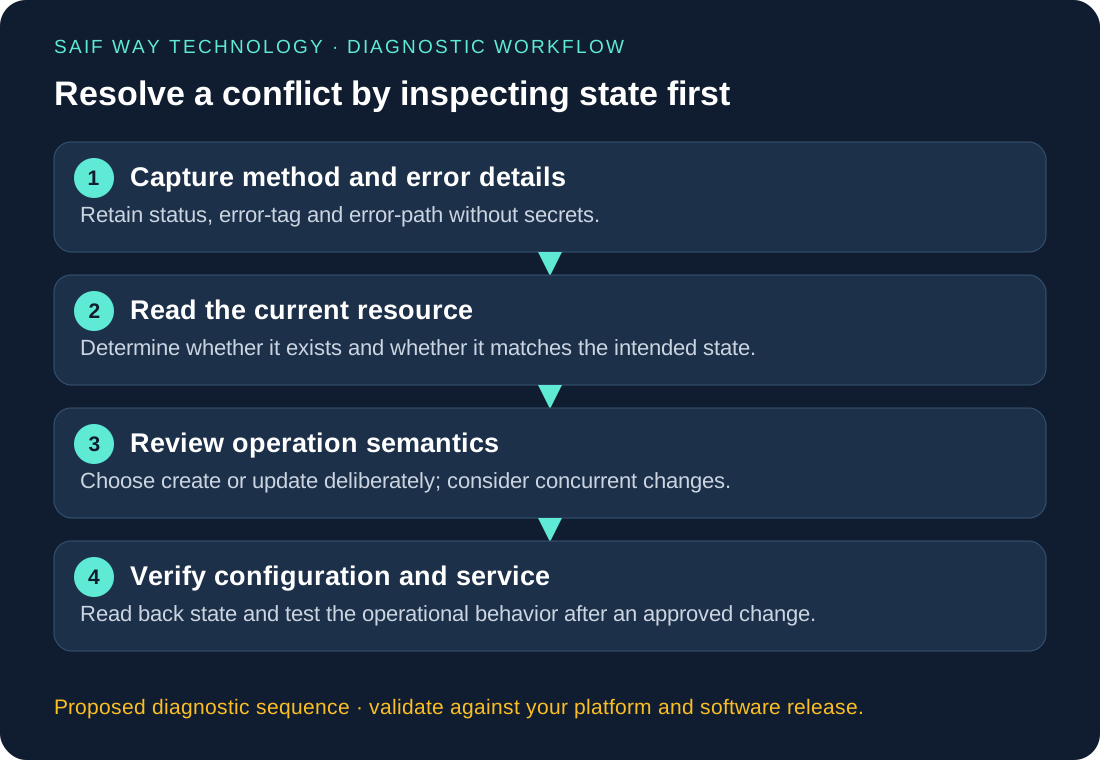
What does RESTCONF 409 Conflict mean for a create request?
Inspect the RESTCONF error information alongside the HTTP code. A data-exists error suggests a creation conflict, but other conditions can also produce 409. A status-only exception removes important context. Record the method and target without exposing credentials or sensitive configuration.
A create request may fail because the target already exists, but another conflict can have a different error-tag. Preserve the HTTP method, target and a redacted RFC 8040 error body. The sample below is synthetic: it demonstrates classification without sending a create request.
Why does changing POST to PATCH require more investigation?
POST creates below a parent resource; PATCH and PUT have different target and replacement/merge semantics. A guessed method change can modify more than intended. Read the existing resource, compare its identity and desired fields, and ask the resource owner to approve the specific reconciliation operation.
Proposed GNS3/EVE-NG lab: examine a repeated create request
In the disposable lab, document parent path, list key and initial state. Plan first create, repeated create, readback and approved cleanup. Do not run these writes against a shared device to generate an error for an article. Offline fixtures can exercise error classification before any lab mutation.
Python: classify a synthetic data-exists error response
The stronger classifier retains every error tag and returns unknown_error_schema for missing/malformed bodies. data-exists selects a read/compare branch, not automatic deletion. Another tag remains a review decision; no generic retry converts an unknown conflict into success.
fixture = {
    'ietf-restconf:errors': {
        'error': [{'error-tag': 'data-exists',
                   'error-path': '/example:resource/item=lab'}]
    }
}
errors = fixture.get('ietf-restconf:errors', {}).get('error', [])
for error in errors:
    tag = error.get('error-tag', 'unknown')
    action = 'read_current_state' if tag == 'data-exists' else 'review_error'
    print({'tag': tag, 'next_step': action})
Worked Python example and input contract
def conflict_tags(payload):
    errors = payload.get('ietf-restconf:errors', {}).get('error')
    if not isinstance(errors, list) or not errors:
        return {'state': 'unknown_error_schema', 'tags': []}
    tags = [item.get('error-tag') for item in errors if isinstance(item, dict)]
    if len(tags) != len(errors) or any(not isinstance(t, str) for t in tags):
        return {'state': 'unknown_error_schema', 'tags': []}
    return {'state': 'read_existing_resource' if 'data-exists' in tags else 'review_conflict',
            'tags': tags}

sample = {'ietf-restconf:errors': {'error': [{'error-tag': 'data-exists'}]}}
print(conflict_tags(sample))  # Synthetic error; no write is issued
How should a repeatable workflow compare existing state?
Define three outcomes: existing state matches, existing state differs, and state could not be read. Only the first may satisfy the defined request without another write. The second needs a scoped change; the third remains unresolved. Keep the original request’s correlation ID.
What evidence should confirm the intended resource state?
Read the same resource after the approved operation and evaluate its intended fields. HTTP success alone does not verify every dependent interface, route or service. A failed readback is unknown rather than proof that the write failed safely.
When would a reconciliation dashboard help?
A dashboard can present the diff, decision owner and operation history while keeping mutation behind a separate authorized workflow. Scope the work to a reviewed resource adapter, not an unrestricted RESTCONF request builder exposed through a web form.
Related troubleshooting and implementation
Explore the network automation troubleshooting collection to connect this issue to adjacent workflows. The Netmiko, NETCONF and RESTCONF comparison helps when you are choosing an interface rather than fixing an existing implementation.