
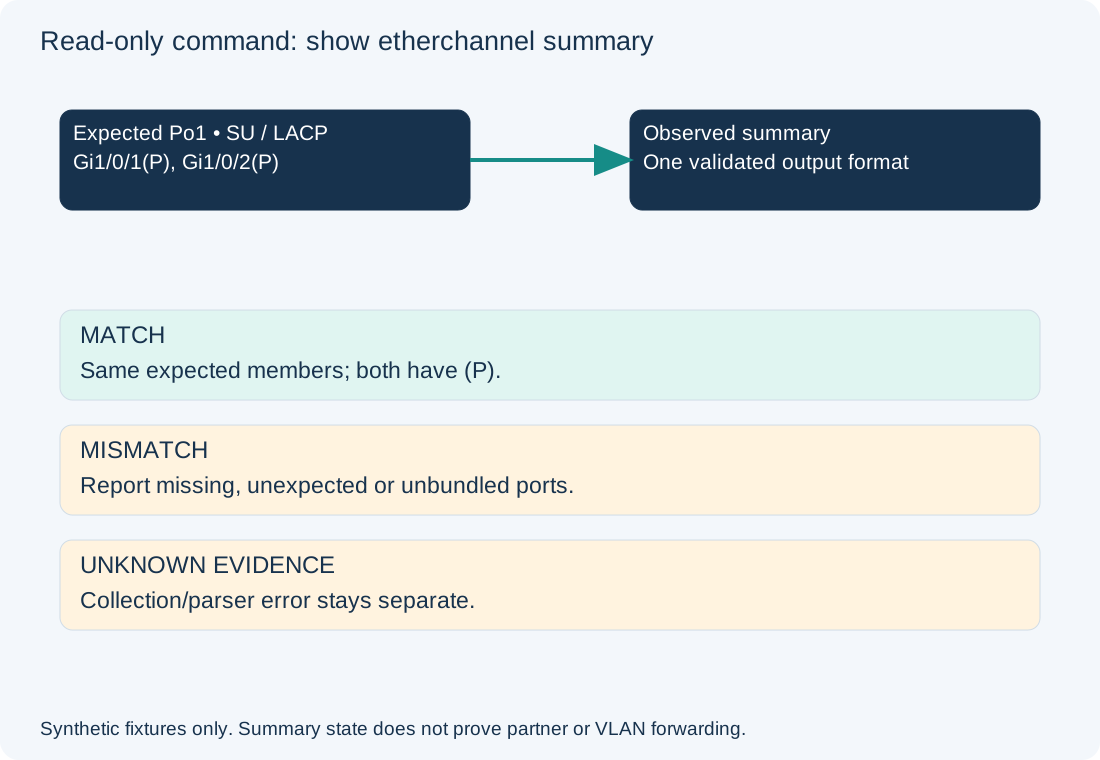
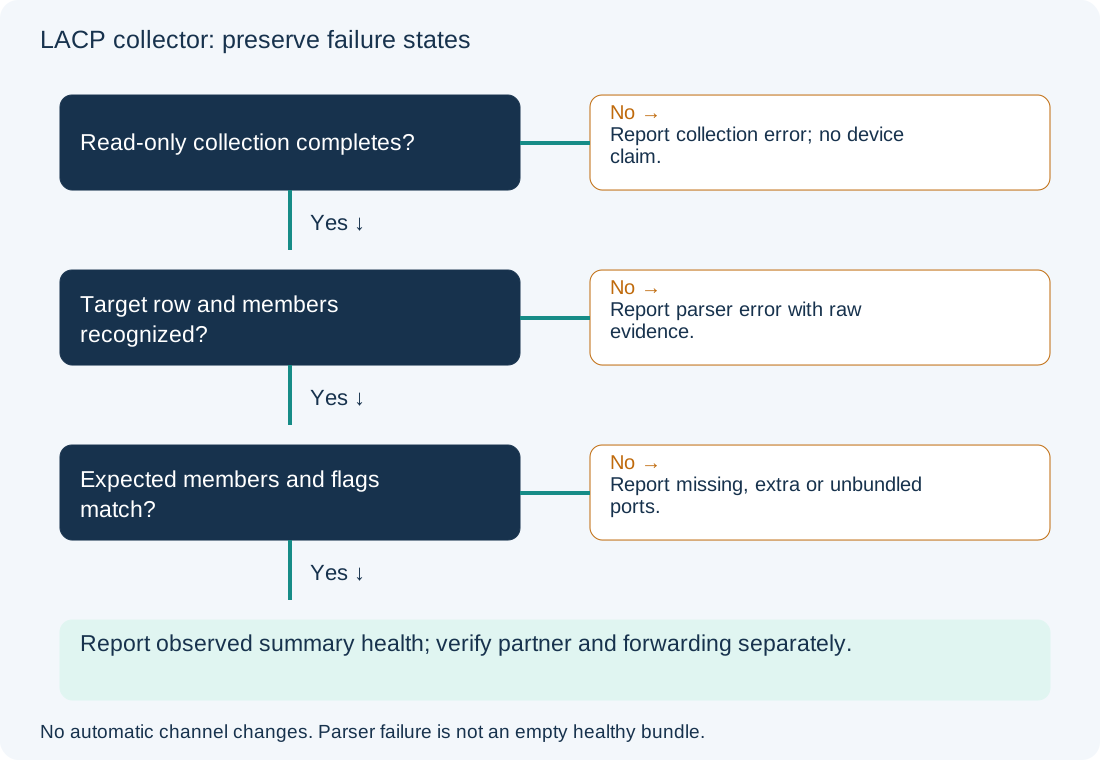
A collector that returns an empty member list after a parser error can falsely report a broken EtherChannel. A collector that treats any visible member as healthy can miss a lost link. Preserve collection status, parsing status and expected-versus-observed membership separately.
Scope and evidence: Python 3.10+ with a deliberately narrow IOS XE show etherchannel summary text contract. Invalid or duplicate expected members return contract_error before observed output is interpreted. Expected group is Po1, protocol LACP, Layer 2 operational flags SU, and members Gi1/0/1 and Gi1/0/2, each bundled with (P). The code accepts a trusted read-only command adapter or saved text; it contains no SSH credentials or configuration commands. Fixtures are synthetic, not captured output. NX-OS, routed port-channels, stacks and differing output formats need their own parser and expected contract.
Define Expected LACP Members and the IOS XE Output Contract
Record the intended device, group, member names and partner evidence outside the collector. Abbreviated interface names must match the validated output format; the example does not guess equivalence between Gi and GigabitEthernet. Po1(SU) and two (P) flags establish only observed summary state. They do not prove the remote partner, trunk forwarding, VLAN access or service health. Cisco’s EtherChannel troubleshooting guide supplies the device-side interpretation.
Python Example: Parse EtherChannel Summary with Explicit Errors
Save this Python code as lacp_evidence.py. Defining it does not connect to a switch. The parser recognizes one IOS-style summary row and member-only continuation lines; pagination, command errors, duplicate members and unknown trailing text are rejected instead of silently discarded.
import re

ROW = re.compile(r"^\s*\d+\s+(Po\d+)\(([^)]+)\)\s+(\S+)\s+(.*)$")
PORT = re.compile(r"([A-Za-z][A-Za-z0-9/.-]*)\(([A-Za-z]+)\)")

def evaluate(raw, expected):
    if not isinstance(expected, dict) or not re.fullmatch(r"Po[0-9]+", str(expected.get("channel", ""))):
        return {"status": "contract_error", "reason": "invalid channel contract"}
    wanted_list = expected.get("members")
    if (not isinstance(wanted_list, list) or not wanted_list
            or not all(isinstance(p, str) and re.fullmatch(r"[A-Za-z][A-Za-z0-9/.-]*", p) for p in wanted_list)
            or len(set(wanted_list)) != len(wanted_list)):
        return {"status": "contract_error", "reason": "invalid expected members"}
    if not isinstance(raw, str) or "--More--" in raw or re.search(r"^\s*%", raw, re.M):
        return {"status": "parse_error", "reason": "invalid or incomplete output"}
    header = None
    tails = []
    for line in raw.splitlines():
        match = ROW.match(line)
        if match:
            if header is not None:
                break
            if match[1] == expected["channel"]:
                header = (match[2], match[3])
                tails.append(match[4])
        elif header is not None and line.strip():
            tails.append(line.strip())
    if header is None:
        return {"status": "parse_error", "reason": "target row not recognized"}
    tail = " ".join(tails)
    pairs = PORT.findall(tail)
    if not pairs or PORT.sub("", tail).strip():
        return {"status": "parse_error", "reason": "member format not recognized"}
    if len({name for name, flag in pairs}) != len(pairs):
        return {"status": "parse_error", "reason": "duplicate member"}
    members = dict(pairs)
    wanted = set(expected["members"])
    missing = sorted(wanted - members.keys())
    unexpected = sorted(members.keys() - wanted)
    not_bundled = sorted(name for name, flag in pairs if flag != "P")
    healthy = (header == ("SU", "LACP") and not missing
               and not unexpected and not not_bundled)
    return {"status": "healthy_observed" if healthy else "mismatch",
            "channel": expected["channel"], "flags": header[0],
            "protocol": header[1], "members": members,
            "missing": missing, "unexpected": unexpected,
            "not_bundled": not_bundled}

def collect(send_command, expected):
    try:
        raw = send_command("show etherchannel summary")
    except Exception as error:
        return {"status": "collection_error", "error_type": type(error).__name__}
    return evaluate(raw, expected)
A missing target row is reported as unrecognized evidence, not proof that the device has no channel. Likewise a command permission error is not a missing member. Keep the original timestamped output securely beside the structured result for review. The broad exception boundary here reports adapter failure without inventing device state; authentication, authorization and transport details should remain typed and sanitized in the real adapter.
Test Missing and Suspended LACP Members Using Offline Fixtures
Append these synthetic fixtures and run python lacp_evidence.py. They call only local functions:
if __name__ == "__main__":
    expected = {"channel": "Po1", "members": ["Gi1/0/1", "Gi1/0/2"]}
    healthy = "1 Po1(SU) LACP Gi1/0/1(P) Gi1/0/2(P)"
    missing = "1 Po1(SU) LACP Gi1/0/1(P)"
    suspended = "1 Po1(SU) LACP Gi1/0/1(P) Gi1/0/2(s)"
    assert evaluate(healthy, expected)["status"] == "healthy_observed"
    assert evaluate(missing, expected)["missing"] == ["Gi1/0/2"]
    assert evaluate(suspended, expected)["not_bundled"] == ["Gi1/0/2"]
    assert evaluate("% Invalid input", expected)["status"] == "parse_error"
    assert collect(lambda command: healthy, expected)["status"] == "healthy_observed"
    print("5 offline fixtures passed")
Expected output is 5 offline fixtures passed. The result does not validate real IOS text, SSH transport or partner selection. Capture representative authorized outputs from each supported platform/build and add fixtures for continuation lines, unknown text and error states before operational use. A structured vendor/API parser can be preferable to extending this intentionally small regular expression indefinitely.
Connect an Approved Read-Only LACP Command Collector
Collection rollout change: save the existing collector/template and pilot one expected group. Supply a trusted adapter with a fixed command allowlist, bounded connect/read deadlines, host-key verification and a least-privilege account. Disable pagination through the adapter’s reviewed session handling; do not leave a CLI prompt or pager in the raw command response. Never pass arbitrary user-supplied command strings to the device. A transport package’s successful return is not proof of complete output; reject truncation and retain command completion metadata.
The callback design keeps the article independent of a specific changing SSH library. An existing Netmiko or pyATS workflow can provide the command output, but its platform driver and exception behavior must be validated separately. No working live adapter is claimed here. The SNMP outcome guide shows the same separation of collection failure from missing data for another protocol.
Verify LACP Evidence and Roll Back the Collector Template
Compare a pilot’s structured result with an authorized manual show etherchannel summary, then check partner identity with show lacp neighbor and VLAN forwarding on the logical interface. If a member is missing or suspended, follow the LACP troubleshooting guide; the collector must not repair it automatically.
Rollback disables the pilot job and restores the saved reporting template. No switch configuration rollback is needed because this collector issues no configuration command. Preserve parser-error records as unknown and alert on persistent collection failure instead of rendering it as success. During a cutover, use the migration evidence contract to decide which observed differences are intended and which require an owner decision.