NLP-Driven Emotion Recognition
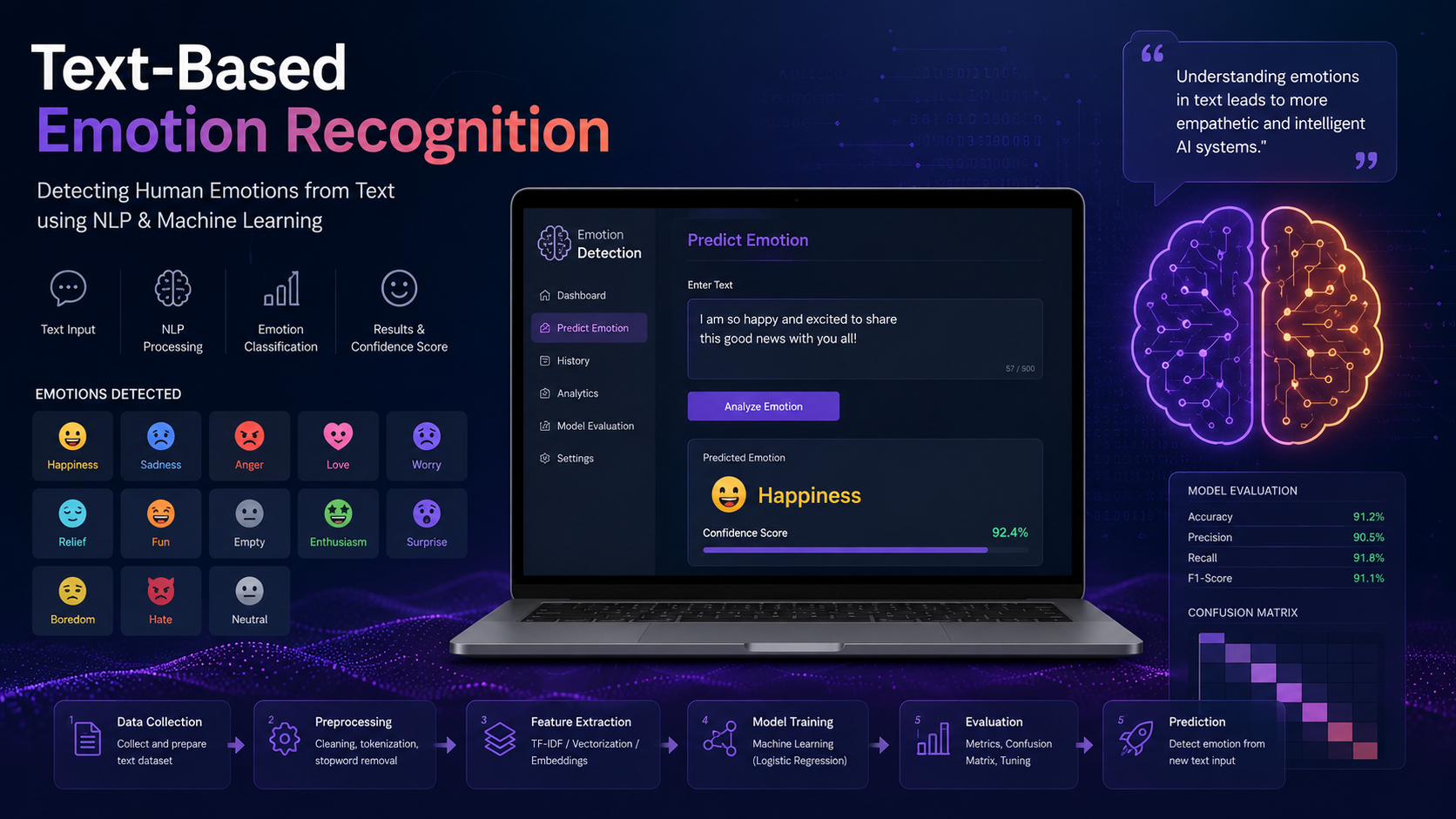
A comprehensive Natural Language Processing project designed to parse transcribed human speech, isolate distinct behavioral properties, and apply predictive machine learning techniques to map textual metrics across 13 fine-grained emotional states.
- 13-Class Emotion Categorization Engine
- Advanced Contextual Tokenization & Text Normalization
- Dense Embedding Integration (Word2Vec, TF-IDF, BERT)
- Adaptive Handling of Mixed or Vague Sentiments

The Detection Challenge
Human conversation is heavily layered with nuance, making it difficult for standard computing workflows to comprehend underlying intent. Traditional rule-based keyword matchers fail to catch implicit shifts in emotional state or mixed contextual structures. To build truly empathetic software systems-such as conversational virtual assistants or text-based mental health support portals-machines must adapt to decipher subtle contextual and semantic cues hidden within raw phrases.
The Engineered Solution
I implemented an automated machine learning and language processing framework to clean, represent, and accurately classify emotional features. Leveraging text preprocessing filters along with highly optimized text classification algorithms, the architecture isolates structural patterns within textual items. The solution assigns accurate emotional indices across multiple targets, complete with dynamic confidence scores and fallback workflows for ambiguous sentiments.
Classification Scope & Processing Pipelines
Target Emotion Vectors
-
Positive Dimensions: High-performance identification for joy-adjacent signals like happiness, love, fun, relief, and enthusiasm.
-
Negative Dimensions: Granular tracking of distressed semantic properties, separating targets into sadness, anger, worry, and hate.
-
Passive & Reactive States: Isolates subtle conversational indicators including neutral, surprise, boredom, and empty expressions.
-
Mixed Emotion Processing: Evaluates probability distributions to handle compound text vectors gracefully, defaulting securely when certainty indexes plateau.
Intelligent NLP Pipeline
Technical Design Ecosystem
| Language Base | Python 3 Environment |
| NLP Libraries | NLTK, spaCy v3 Frameworks |
| Text Embedding | TF-IDF, Word2Vec, BERT Transformers |
| Classification Core | Multi-Class Logistic Regression Classifier |
| Metrics Validation | Precision, Recall, F1-Score Matrices |
| Process Lifecycle | VU Process Model (Waterfall / Spiral Mix) |
| User Interfaces | Command-Line (CLI) / Light Web Form Viewports |
Engineering & Architecture Perspective
The system logged high precision and recall indices across dominant data classes (such as love, happiness, neutral, and hate) due to sample abundance within the core corpus. Conversely, minority target classes (like boredom) displayed reduced optimization due to strict dataset class imbalances. This establishes an explicit iteration path for integrating targeted oversampling configurations to improve structural performance across all minority prediction nodes.
NLP-SER
Emotion Recognition Engine
Project Assets & Codebase
Review the production application source tree, serialized runtime pipelines, and implementation files.