
ML-Powered Cyber Attack Detection
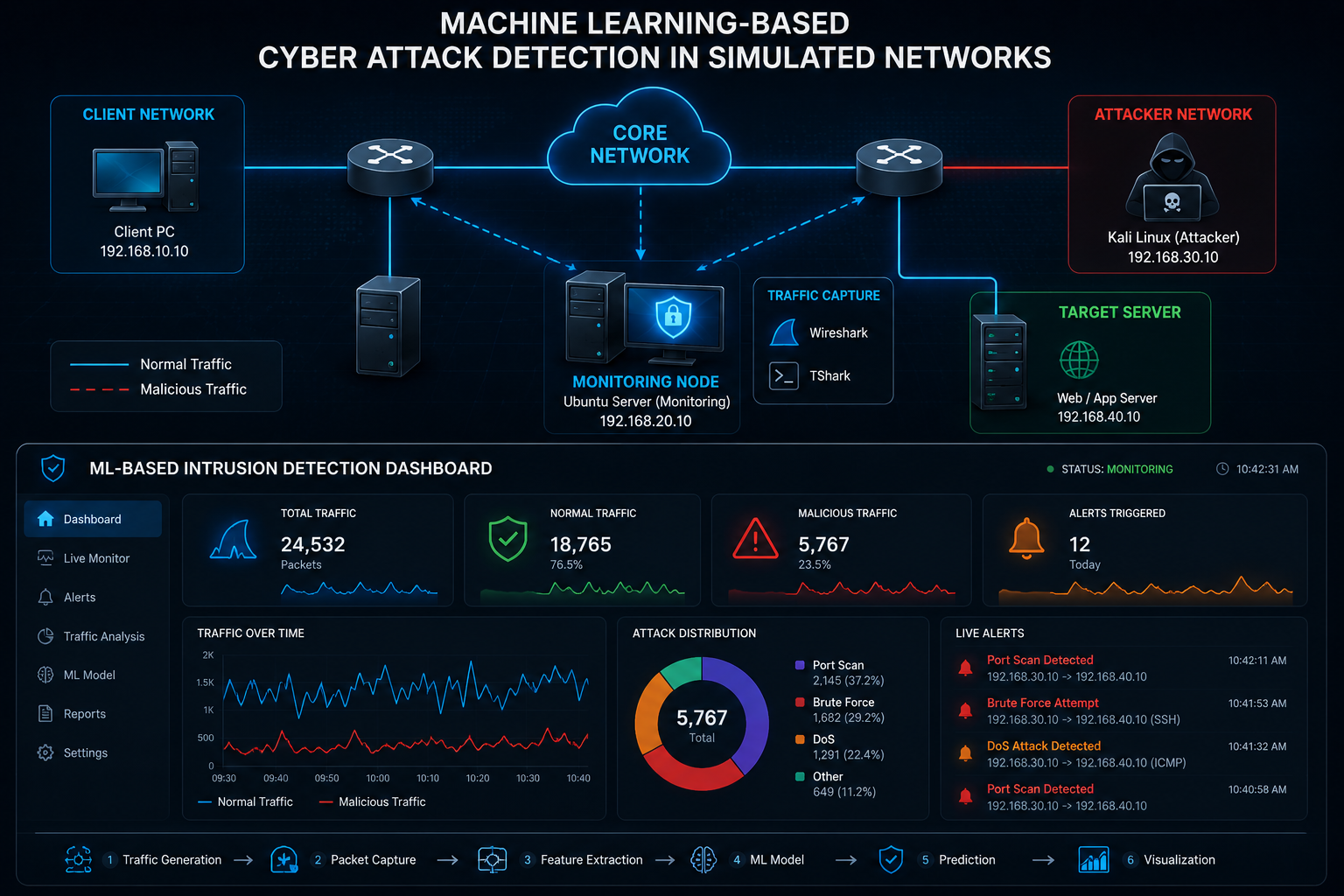
A practical cybersecurity engineering project designed to simulate real-world attack scenarios, capture network traffic, extract behavioral features, and apply machine learning techniques to identify malicious activities in near real-time.
- Enterprise Network Simulation using GNS3
- Real Traffic Capture & Packet Analysis via Wireshark/Tshark
- Machine Learning-Based Attack Classification
- Flask Dashboard for Threat Visualization
The Detection Challenge
Traditional security monitoring solutions often depend on static signatures and predefined rules. As cyber threats continue evolving, organizations require more intelligent detection mechanisms capable of identifying abnormal behavior patterns within network traffic. Detecting suspicious activity before it impacts critical systems remains one of the biggest challenges for modern security teams.
The Engineered Solution
I designed a simulated enterprise network environment where both legitimate and malicious traffic could be generated, captured, analyzed, and classified. Using machine learning models and traffic feature extraction techniques, the platform was able to distinguish normal network activity from cyber attacks and present the results through a real-time monitoring dashboard.
Simulated Scenarios & Functional Capabilities
Attack Vector Coverage
-
Port Scanning: Simulated reconnaissance attempts used to identify open ports and exposed services.
-
Brute Force Attacks: Repeated authentication attempts generated against target infrastructure systems.
-
Denial of Service (DoS): High-volume traffic patterns generated to simulate network resource exhaustion attacks.
-
Suspicious Access Attempts: Unauthorized cross-zone traffic flows introduced to evaluate anomaly detection capability.
Intelligent Detection Pipeline
Technical Design Ecosystem
| Network Emulator | GNS3 (Enterprise Lab Virtualization) |
| Attack Platform | Kali Linux (Malicious Traffic Generation) |
| Monitoring Platform | Ubuntu Linux (IDS Node Engine) |
| Packet Analysis | Wireshark, Tshark Engine |
| Programming Language | Python 3 |
| Machine Learning | Scikit-Learn (Random Forest, SVM Algorithms) |
| Dashboard Framework | Flask (Real-Time Web Interface UI) |
| Data Analysis | Pandas, NumPy Arrays |
Security Engineering Perspective
This project demonstrates the convergence of networking, cybersecurity, machine learning, and software development. Beyond simply identifying attacks, it explores how behavioral analysis and intelligent monitoring can enhance security visibility and support modern SOC, detection engineering, and threat hunting operations.
AI-Powered IDS
Intelligent Threat Detection
Project Assets & Demonstration
Review the project source code, machine learning implementation, and live attack detection demonstrations.