
Multi-Router LAN Security & Routing Design
A hands-on network simulation modeled in Cisco Packet Tracer to demonstrate enterprise-grade LAN segmentation, secure wireless environments, port-level hardware authorization, and instant rogue device threat mitigation.
- Dynamic Path Selection using RIP v2 Routing
- Layer-2 Access Security via Layered Port Constraints
- Secure Wireless Access Panels with MAC Address Filters
- OSI & TCP/IP Model Structural Layer-by-Layer Alignment

The Infrastructure Challenge
Enterprise multi-department networks frequently face structural performance and vulnerability risks due to missing boundary segmentation. Unrestricted communication across networks increases broadcast loops, leaves open network sockets vulnerable to unauthenticated hardware attachments (rogue access attempts), and complicates basic access traffic policing.
The Engineered Solution
I built and validated a fully simulated, segmented multi-router architecture. By leveraging dynamic routing protocols alongside port security validation policies and secure wireless routing overlays, unauthenticated rogue equipment attachments are dropped in real-time while authorized departmental paths maintain secure communication metrics.
Core Simulation Framework Pillars
Dynamic Routing
Deploys classless RIP v2 dynamic tracking tables across routers to preserve multi-subnet inter-LAN data packet movement path targets.
Port Access Control
Enforces maximum allowed MAC addresses per local switchport interface, triggering immediate auto-shutdown/restriction traps upon violation.
Wireless Hardening
Combines strong WPA2-PSK access credentials with strict Layer-2 white-list MAC hardware registration lists to drop rogue clients.
Structural Verification
Utilizes comprehensive Packet Tracer simulation tools to run full layer-by-layer packet capture trace lookups mapping onto OSI definitions.
Functional Capabilities
- LAN Segmentation: Segments internal departmental endpoints across isolated subnet spaces to limit open broadcast pollution.
- Rogue Device Drop: Switch hardware locks access down the moment unlisted physical terminal signatures connect.
- End-to-End Testing: Validates end-to-end traversal matrices using strict terminal ping commands and structural routing-table audits.
- MAC Filtering Layers: Implements white-list filtering maps at the wireless router edge to reject malicious radio associations.
Technical Design Ecosystem
| Core Simulator | Cisco Packet Tracer Engine |
| Simulated Hardware | Cisco ISR Routers, Catalyst Access Switches, Wireless AP Nodes |
| Routing Architecture | RIP v2 Dynamic Matrix, Subnet Addressing Arrays |
| Edge Validation | Layer-2 Switchport Security, MAC Filtering Maps, WPA2 Cryptography |
| Analysis Methodologies | OSI Multi-Layer PDU Capture Tracing, System Violation Logging |
Network Topology Architecture Layout
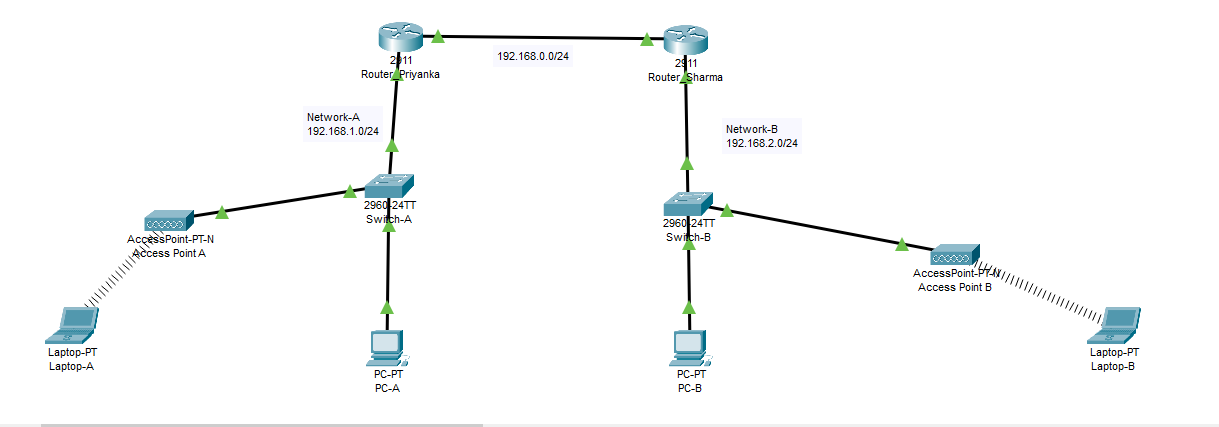
Network Security Engineering Perspective
This lab environment builds directly onto core enterprise infrastructure design basics. Moving past open, flat layout setups to construct multi-router routing domains controlled by strict layer-2 and wireless access restrictions shows a strong practical understanding of core defensive principles needed across production enterprise positions.
Secure LAN
Hardware Mitigated Architecture
Project Assets & Verification
Review the localized configuration guidelines, retrieve simulation files, or watch the step-by-step terminal execution tutorial.