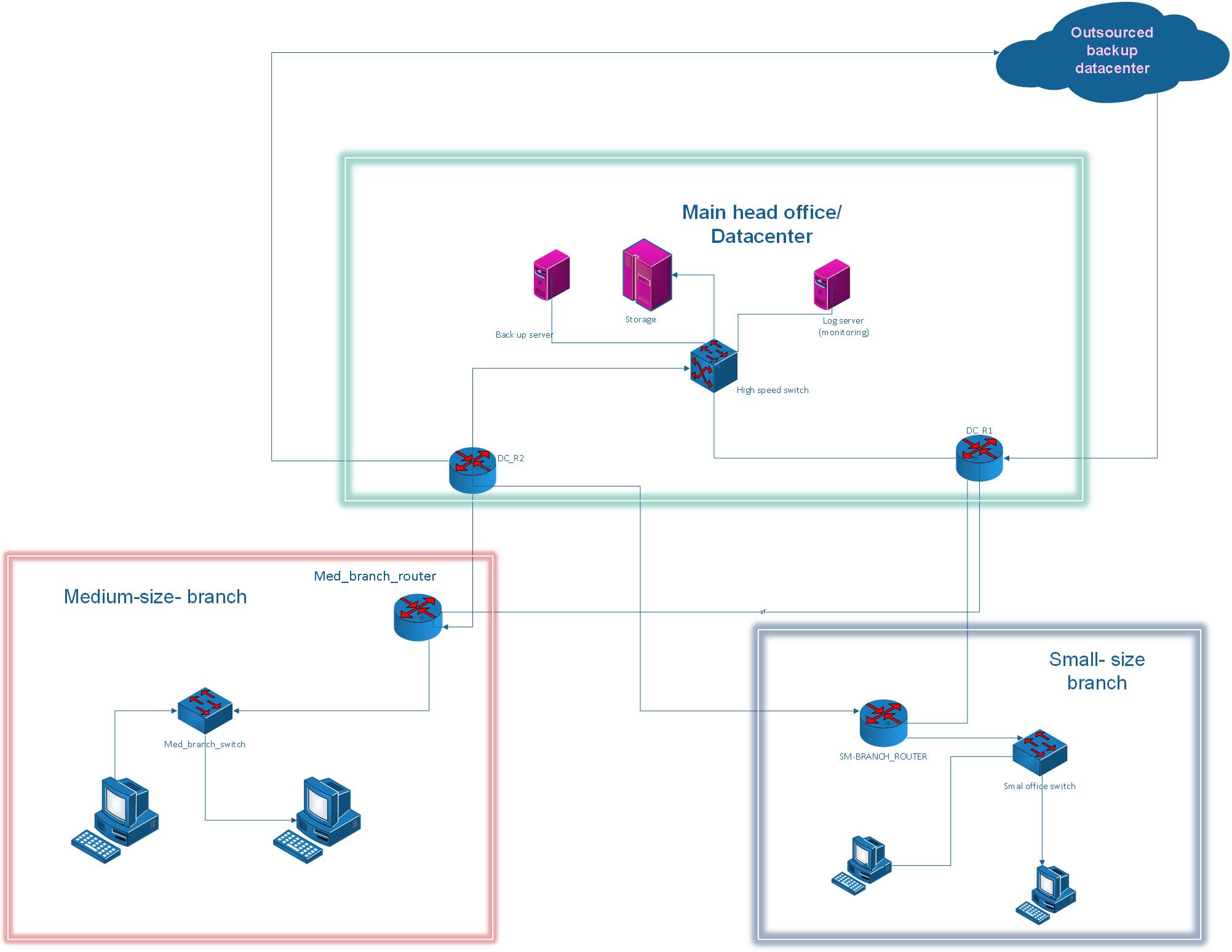
Project Overview
This project focuses on the design and implementation of a hybrid network architecture to support outsourced data center backup operations. The network ensures secure communication, high availability, and optimized performance through QoS and segmentation policies.
The proposed design integrates:
- Backup Server – Deployed within the organization’s on-premises data center to manage backup operations.
- Storage Devices – Network Attached Storage (NAS) or SAN-based storage systems for local backup storage.
- Network Infrastructure – High-bandwidth, segmented network with QoS for prioritizing backup traffic.
Case Study: Hybrid Network Backup Design
Problem:
Organizations require secure and reliable backup connectivity between on-premises infrastructure and cloud data centers.
Solution:
Implemented a hybrid network design using OSPF routing, VPN GRE tunnels, ACL-based security, and QoS policies to protect and prioritize backup traffic.
Result:
A secure, scalable backup network topology with high availability, optimized performance, and centralized monitoring.
Project Scope
The network is designed to guarantee the security, integrity, and reliability of communication between:
- On-Premises Data Center (Core Server, Monitoring Server, Backup Server)
- Two Remote Sites – Connected via serial links with high availability enabled between them.
- Cloud Data Center – Integrated using secure VPN GRE tunnels.
- OSPF Routing – For dynamic, efficient path selection.
- ACL Security – To filter and protect network traffic.
- QoS – To optimize bandwidth usage and prioritize critical backup traffic.
Network Design Lab Overview
This project can also be treated as a network design lab, where OSPF routing, VPN GRE tunneling, ACL security, and QoS policies were validated using simulated environments. The lab tested routing convergence, tunnel stability, and secure backup traffic flow.
Objectives
- Develop a comprehensive hybrid architecture aligned with organizational security requirements.
- Clearly define the number and roles of routers and switches in the design.
- Assess the existing network infrastructure for compatibility and connectivity.
- Identify vulnerabilities and potential security weaknesses.
- Enable real-time monitoring and logging for proactive threat detection.
- Provide comprehensive documentation and training for IT staff.
Requirements Delivered
- Topology Diagram (Visio-based, professional format)
- Test Cases ensuring reliable communication
- Configuration Commands for:
- OSPF Routing
- VPN GRE setup
- ACLs for access control
- QoS for traffic optimization
- Security gap analysis and integration with existing infrastructure
Tools & Technologies
- Cisco Packet Tracer (Latest Version)
- Microsoft Visio (Topology Design)
- Networking protocols: OSPF, VPN GRE
- Security controls: ACLs, QoS
Outcome
The implemented hybrid network provides:
- Reliable inter-site connectivity with high availability
- Secure cloud integration for outsourced backup services
- Optimized traffic flow for backup operations
- Real-time monitoring capability
- A scalable and secure foundation for future expansions
Topology:
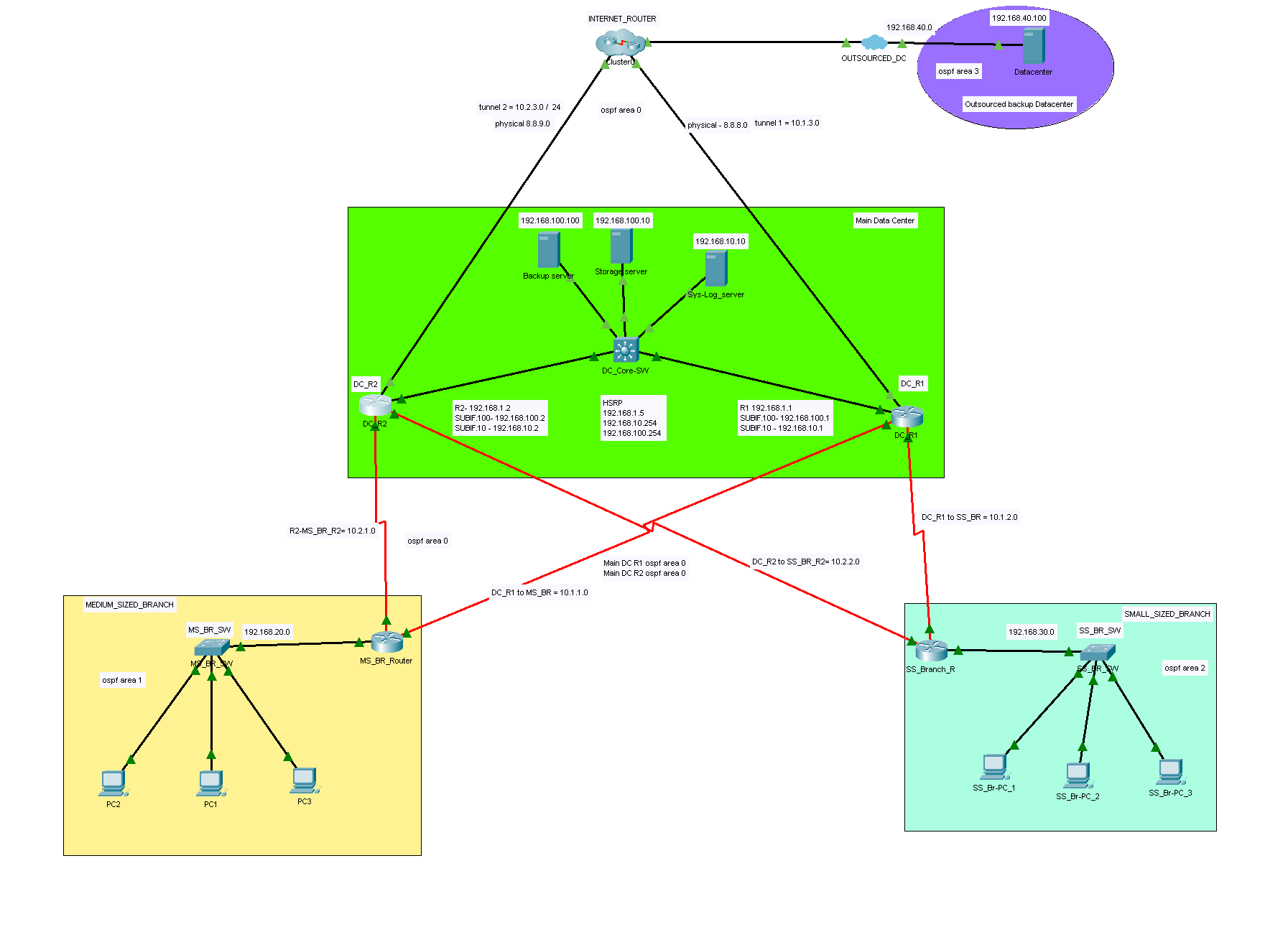
Presentation:
Semantic Keyword Reinforcement
This project demonstrates practical network designing principles including:
- topology planning
- protocol selection
- redundancy
- security zoning
- traffic optimization
It serves as a reference for network design case studies, network topology labs, and portfolio projects for aspiring network engineers.